
 Introduction
Rotary drilling piles are increasingly used in urban deep foundation pit support construction due to their advantages of fast construction speed, high precision, low noise, environmental friendliness, and convenient machine mobility. However, common issues such as significant soil disturbance, poor hole wall protection, excessive sediment thickness, and inter-pile cross-hole formation often arise during construction.
This article discusses quality control measures for rotary drilling piles in deep foundation pit support construction, including adjusting penetration speed, optimizing slurry density, and improving construction sequencing to enhance hole-cleaning efficiency and increase time intervals between adjacent pile construction.
Project Case Study
1. Project Overview
The Science Avenue-Daguan Road Tunnel Project is located at the intersection of Yunxi Road, Science Avenue, and Daguan Road in Guangzhou. It is a 895-meter-long bidirectional six-lane underpass constructed using the open-cut method with support piles.
The foundation pit support system consists of Φ1000mm and Φ1200mm bored piles with a net spacing of 20cm and lengths ranging from 10.5m to 24.7m, totaling 607 piles.
The site’s geological composition, from top to bottom, includes:
-
Miscellaneous fill
-
Fine sand
-
Alluvial silty clay
-
Medium sand
-
Slope-deposited silty clay
-
Completely weathered granite
-
Highly weathered granite
The pile tips are embedded in clay or medium sand layers. According to geological surveys, the soft silt layer is prone to seismic subsidence, while saturated sand layers exhibit slight liquefaction (liquefaction index I1E = 0.19–4.77).
2. Rotary Drilling Pile Construction Process
The project utilized rotary drilling rigs, with construction techniques similar to traditional bored (percussion) piles except for the rotary drilling method used for hole formation.
Common Issues in Rotary Drilling Support Pile Construction
1. Significant Soil Disturbance and Poor Hole Wall Protection
Due to the fast drilling speed of rotary drilling rigs and the absence of slurry circulation during excavation, hole wall stability is inferior compared to traditional bored or percussion piles. Collapse and necking frequently occur in fill and soft soil layers.
Excessive soil disturbance also leads to hole enlargement. Concrete pouring records indicate that actual concrete volume often exceeds theoretical calculations by over 10%, whereas traditional drilling methods typically show a 5%–10% over-pour rate.
2. Excessive Sediment Thickness at Hole Bottom
Poor hole wall protection increases the risk of excessive sediment accumulation due to deep cutting or wall collisions during drilling. Field measurements show that sediment thickness often exceeds 50cm after initial cleaning.
While sediment thickness has minimal impact on support pile functionality, low-strain integrity testing reveals that excessive sediment reduces wave reflection detection success rates. Additionally, excessive sediment negatively affects pile bearing capacity, hindering the adoption of rotary drilling for large-diameter load-bearing piles.
3. Small Adjacent Pile Spacing Leading to Cross-Hole Formation
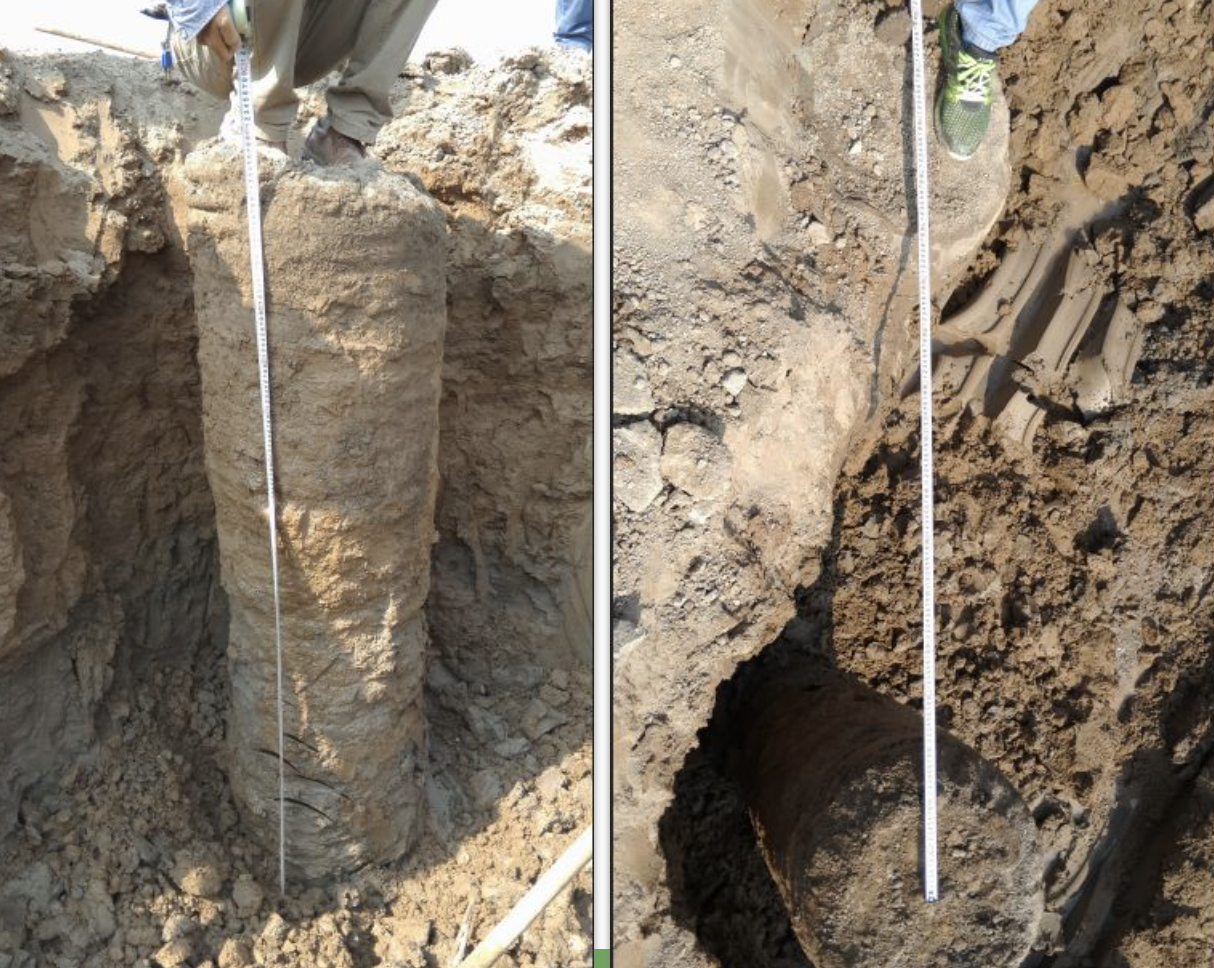
In deep foundation pit support projects, adjacent piles are often closely spaced to ensure soil stability. Traditional construction methods employ the “skip-pile method” to minimize disturbance. However, due to the high soil disturbance and poor slurry protection in rotary drilling, cross-hole issues may still occur even after adjacent piles have set.
Quality Control Measures for Rotary Drilling Pile Construction
1. Adjusting Penetration and Lifting Speed Based on Soil Conditions
Rotary drilling rigs offer faster hole formation (up to 1m/min), but excessive speed increases soil disturbance and cross-hole risks. Recommended penetration speeds:
-
Clay: 0.5–1 m/min
-
Fill or sandy layers: 0.3–0.5 m/min
-
Hard-to-soft layer transition: Increase speed
-
Soft-to-hard layer transition: Reduce speed
-
Prone-to-shrinkage layers: Increase reaming passes
-
Hard layers: High rotation speed for efficiency
-
Sandy layers: Low speed with increased slurry density
Lifting speed should also be controlled to prevent vacuum-induced wall collapse:
-
Clay: 1–2 m/min
-
Fill or sandy layers: 0.5–1 m/min
2. Optimizing Slurry Density and Implementing Secondary Hole Cleaning
High-quality bentonite slurry should be prepared to stabilize hole walls. Adjust slurry density based on soil conditions:
| Soil Type | Slurry Density (g/cm³) | Viscosity (s) |
|---|---|---|
| Clay | 1.05–1.10 | 18–22 |
| Sandy layers | 1.10–1.20 | 22–28 |
| Collapsible layers | 1.20–1.30 | 25–30 |
Secondary hole cleaning (reverse circulation method) ensures sediment thickness meets standards before concrete pouring.
3. Implementing the “Skip-3-Pile Method” to Increase Adjacent Pile Interval
Traditional skip-pile methods require a 48-hour interval between adjacent piles. However, due to high soil disturbance in rotary drilling, a “skip-3-pile method” is recommended:
-
Drill Pile 1
-
Skip 3 piles, drill Pile 5
-
After Piles 1 & 5 are poured, drill Pile 3
-
After Pile 3 sets, drill Piles 2 & 4
This method increases soil stability between adjacent piles, reducing cross-hole risks. Field data shows concrete over-pour reduced from >10% to 4.7%, with over 90% of piles classified as Class I in integrity tests.
Conclusion
Rotary drilling piles are widely used in deep foundation pit support due to their speed, low noise, and reduced slurry pollution. By controlling penetration speed, optimizing slurry density, and increasing adjacent pile intervals, construction quality can be significantly improved.
However, unlike traditional bored piles, rotary drilling lacks standardized national or industry regulations. Establishing specific guidelines for rotary drilling parameters will further promote its application in foundation pit support and other pile foundation projects.