Introduction to Bored Piles
Bored piles, also known as drilled shafts, are deep foundation elements constructed by drilling a hole into the ground, installing a reinforcement cage, and filling it with concrete. This method is widely used in construction projects where stable load-bearing capacity is required.
Step-by-Step Construction Process
1. Site Preparation
-
Dry Land: Level and compact the ground.
-
Shallow Water: Construct an artificial island.
-
Deep Water: Use a cofferdam or retaining structure.
2. Installing the Casing Pipe (Guide Tube)
Functions of the Casing Pipe:
-
Stabilizes the borehole position.
-
Protects the hole opening.
-
Prevents surface water infiltration.
-
Enhances internal water pressure to avoid collapse.
-
Guides the drilling tool.
Specifications for Casing Pipe:
-
Materials: Reinforced concrete or steel (4–8 mm thick for steel, 8–10 cm for concrete).
-
Diameter: 20–40 cm larger than the designed pile diameter, depending on the drilling method.
-
The top section includes 1–2 overflow holes.
Installation Requirements:
-
Excavate and position the casing pipe using digging, hammering, vibration, or pressurization.
-
Typical embedment depth: 2–4 m (deeper in special cases).
-
The top elevation must meet water level requirements.
3. Slurry Preparation
Functions of Slurry:
-
Stabilizes borehole walls.
-
Suspends drill cuttings.
-
Lubricates drilling tools.
-
Facilitates debris removal via circulation.
Composition & Requirements:
-
Water: pH 7–8, free of impurities.
-
Clay/Bentonite: Plasticity index >25, fine particle content >50%, density 1.1–1.5.
-
Additives:
-
Inorganic (e.g., soda ash) to prevent particle settling.
-
Organic (e.g., tannin extract) to reduce viscosity.
-
4. Drilling Rig Setup
Key Requirements:
-
Must support the drilling equipment weight with sufficient stiffness and height.
-
The rig must remain stable, aligned, and free from tilting or sinking.
-
Secure the base with wooden blocks and anchor the top with cables.
5. Drilling Methods
A. Impact Drilling
-
Uses a heavy drill bit to break rock/soil.
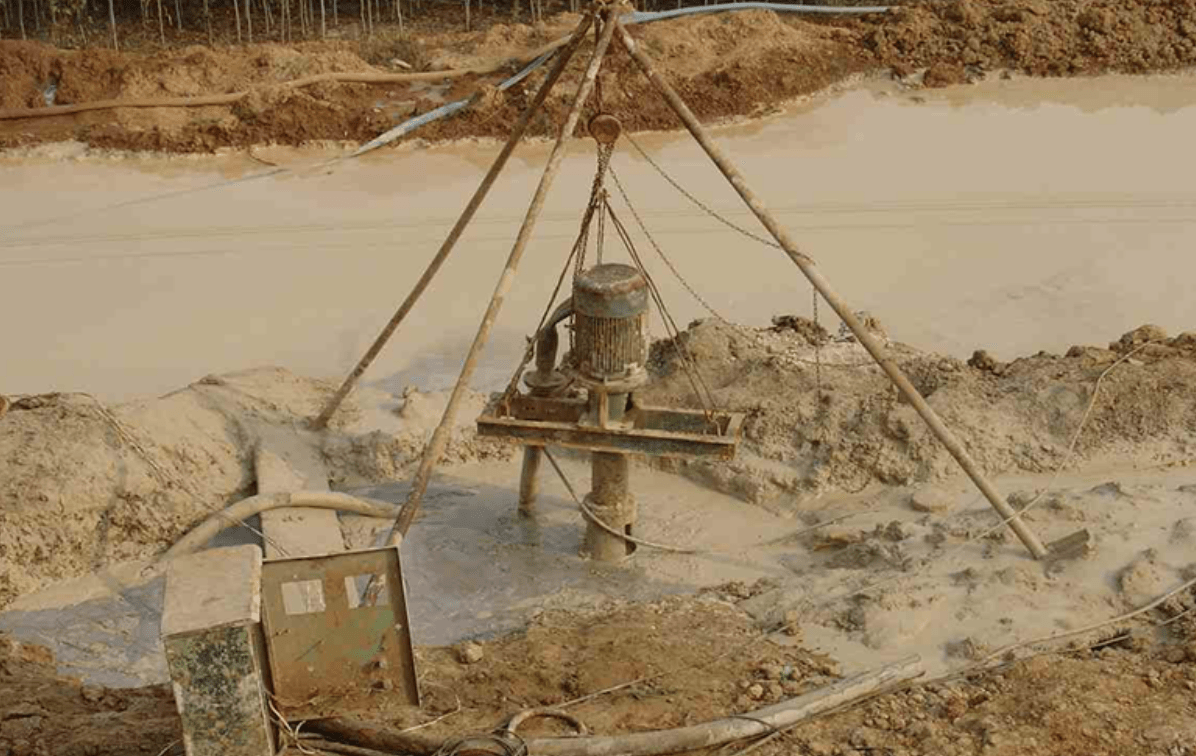
B. Rotary Drilling (Direct/Reverse Circulation)
Direct Circulation:
-
Mud is pumped through the drill pipe, lifting cuttings to the surface.
-
Pros: Simple operation, cost-effective.
-
Cons: Slow, high wear, weak debris removal.
-
Suitable for: Clay, silt, sand, gravel, bedrock.
Reverse Circulation:
-
Mud flows into the hole while a vacuum pump extracts cuttings.
-
Pros: Strong debris removal.
-
Cons: Complex process, risk of collapse, expensive.
-
Suitable for: Similar to direct circulation but more efficient.
C. Auger Drilling (Modern Method)
-
Uses a rotating bucket to excavate soil.
-
Pros: Fast, precise, low pollution, high efficiency.
-
Suitable for: Sand, clay, loam.
-
Capabilities: Max diameter 1.5–4 m, depth 60–90 m.
6. Hole Cleaning
Purpose: Remove sediment to ensure proper concrete bonding.
Methods:
-
Slurry replacement.
-
Sediment removal.
7. Reinforcement Cage Installation
Key Points:
-
Add stiffening rings (Ø14–18 mm) every 2–2.5 m.
-
Prefabricate in sections if needed.
-
Ensure proper concrete cover thickness.
-
Lift and lower carefully to avoid deformation or wall contact.
-
Cut lifting rings once the concrete begins setting.
8. Underwater Concrete Pouring
Requirements:
-
Use high-workability concrete (one grade stronger than the design).
-
Tremie Method:
-
Fill the pipe before releasing concrete.
-
Initial embedment depth ≥ 0.8 m.
-
Maintain 2–4 m embedment during pouring (never <1 m or >6 m).
-
Pour continuously without interruption.
-
Overfill to ensure full coverage (min. 5% of pile length or 2 m).
-
9. Quality Control & Inspection
Critical Checkpoints (Requiring Engineer Approval):
-
Casing pipe positioning.
-
Drilling rig alignment.
-
Reinforce cage quality.
-
Hole depth, diameter, and verticality.
-
Cleanliness before concreting.
-
Proper tremie pipe placement (40–50 cm above base).
-
Backup equipment readiness for uninterrupted pouring.
-
Slurry viscosity and density.
-
Reinforcement cage positioning.
-
Continuous concrete placement with proper embedment.
-
Real-time monitoring of pour progress.
Conclusion
Bored pile construction demands precision in drilling, reinforcement, and concreting to ensure structural integrity. Proper execution of each step—from site prep to final inspection—guarantees optimal load-bearing capacity and long-term stability. Following industry best practices and stringent quality checks minimizes risks and enhances project success.