
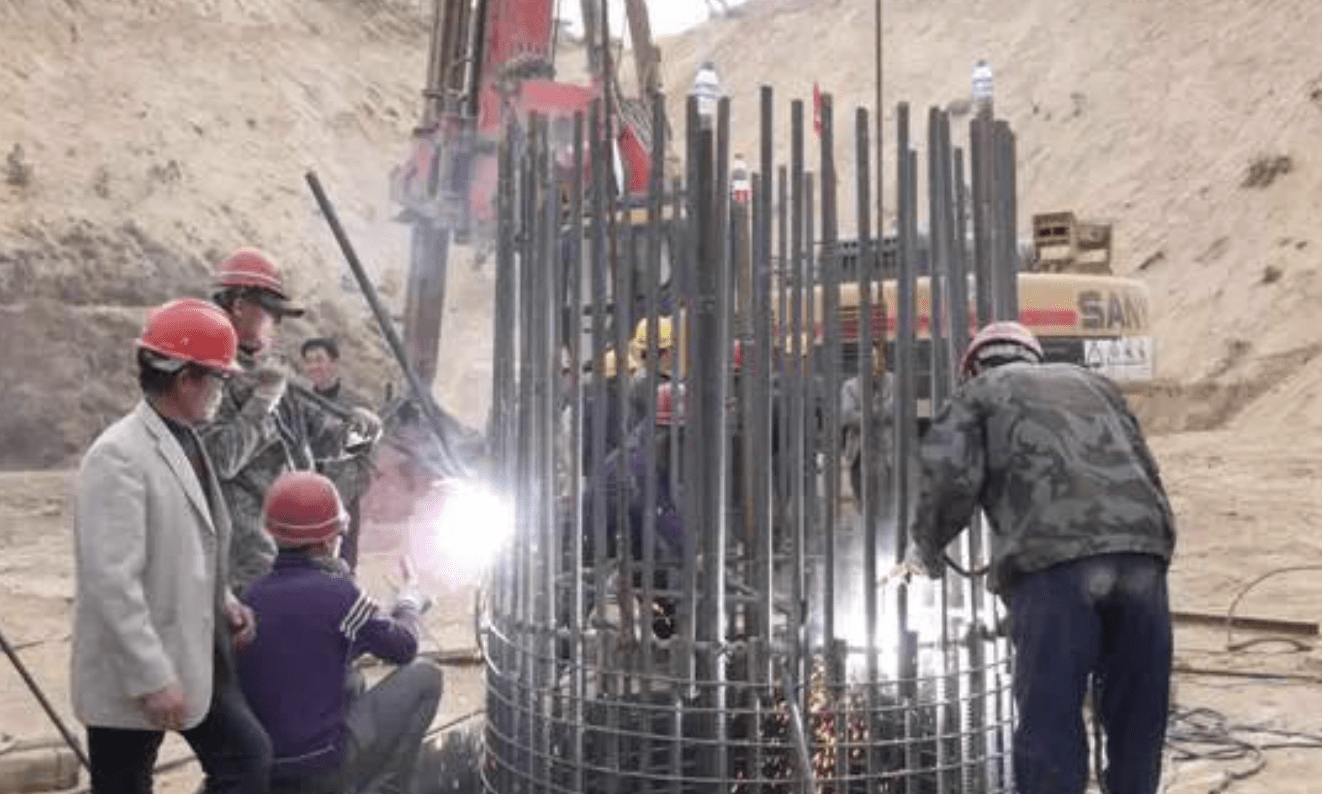
I Foundation and Base Construction
1. Poor Verticality of Pile Shaft
Causes:
-
Failure to verify verticality during manual excavation pile construction leads to deviations.
Prevention Measures:
-
Use cross-line pendulums at each construction stage to check and adjust pile shaft verticality.
2. Pile Top Slurry Buildup
Causes:
-
Excessive water-cement ratio in pumped concrete, resulting in thick slurry accumulation, reduces compressive strength.
Prevention Measures:
-
Pour concrete 30–50 mm above design height, remove excess slurry before initial setting, and manually chisel to expose aggregate after final setting.
-
Supervise and document each pile with photos.
3. Offset of Short-Limb Wall Reinforcement
Causes:
-
Dense lower reinforcement causing misalignment.
-
Lack of reinforcement fixing before concrete pouring.
Prevention Measures:
-
Weld or add stirrups to secure reinforcement.
-
Use steel pipes or wooden frames to fix the upper reinforcement and verify alignment.
-
Adjust reinforcement post-pouring and enhance on-site supervision.
4. Beam Axis Misalignment
Causes:
-
Failure to verify axis alignment after beam formwork installation.
Prevention Measures:
-
Measure all axes and diagonals accurately.
-
Clarify the relationship between central and eccentric axes.
-
Ensure full-axis verification by supervisors.
II. Main Structural Works
1. Formwork Installation
Irregular Support System & Slab Deflection
Causes:
-
Uncompacted foundation soil.
-
Excessive support spacing, missing locking bars, or poor-quality materials.
Prevention Measures:
-
Follow approved construction plans strictly.
-
Ensure proper foundation compaction and use wooden/steel pads for load distribution.
-
Maintain support spacing:
-
Slabs: 800–1000 mm
-
Beams (<750 mm height): 800–1000 mm
-
Beams (≥750 mm height): 600–800 mm
-
-
Add cross-bracing and locking bars at 200 mm height.
Premature Removal of Post-Pour Strip Supports
Causes:
-
Non-independent support systems and insufficient concrete curing time.
Prevention Measures:
-
Keep post-pour strip supports separate; remove only after concrete reaches ≥75% strength (≥100% for spans >8m).
Axis Deviation & Formwork Bursting
Causes:
-
Uncorrected reinforcement misalignment and excessive concrete pressure.
Prevention Measures:
-
Add ≥2 stirrups to short-limb walls and verify alignment post-pouring.
-
Keep beam side support spacing ≤400 mm.
-
Avoid exposing the main reinforcement during rectification.
2. Reinforcement Installation
Poor Welding Quality in ESW Joints
Causes:
-
Unskilled workers, misaligned bars, or excessive pressure during welding.
Prevention Measures:
-
Allow only certified welders.
-
Ensure bar alignment, repair worn fixtures, and maintain proper pressure.
-
Wait 2 minutes before removing fixtures post-welding.
Excessive Joints in One Section
Causes:
-
Poor material planning and overlapping joints in critical zones.
Prevention Measures:
-
Stagger joints per design requirements (35d or 500 mm spacing).
Sinking of Secondary Beam Reinforcement
Causes:
-
Improper fixing and vibration-induced displacement.
Prevention Measures:
-
Use temporary spacers or open stirrups to secure secondary bars.
Incorrect Beam-Column Joint Lap Length
Causes:
-
Ignoring lap length standards for tension/compression zones.
Prevention Measures:
-
Follow code-specified lap lengths (adjust for joint density: 1.2x for 25–50%, 1.35x for >50%).
Improper Anchoring of Retaining Wall Reinforcement
Causes:
-
Uneven inner/outer bar lengths.
Prevention Measures:
-
Label and install bars with a 50 mm height difference.
3. Concrete Works
Honeycombing, Cracking, and Leakage
Causes:
-
Poor formwork sealing, inadequate vibration, or early demolding.
Prevention Measures:
-
Clean/form oil formwork, vibrate thoroughly (insert 50 mm into lower layers).
-
Use proper spacers (≤600 mm spacing for slabs, ≤200 mm for beams).
Cold Joints & Poor Curing
Causes:
-
Residual debris and improper joint treatment.
Prevention Measures:
-
Clean joints, apply cement slurry, and inspect before pouring.
Slab Surface Cracks
Causes:
-
Insufficient finishing, early loading, or unstable supports.
Prevention Measures:
-
Double-trowel finish, cure ≥7 days, and ensure rigid base support.
Incorrect Curing of Test Specimens
Causes:
-
Specimens not stored on-site or matched to structural conditions.
Prevention Measures:
-
Store specimens in locked boxes, maintain 600°C·d curing (14–60 days).
Improper Construction Joint Placement
Causes:
-
Unapproved joint locations or emergency deviations.
Prevention Measures:
-
Predefine joints in construction plans and obtain design approval for changes.
4. Masonry Works
Unmeasured Mortar Mixing
Causes:
-
Volumetric mixing, improper additives.
Prevention Measures:
-
Use weight-based mixing, vertical mixers, and lab-tested additives.
Dry Brick Laying
Causes:
-
Bricks not pre-wetted, reducing bond strength.
Prevention Measures:
-
Soak bricks 1–2 days before use.
Missing/Short Tie Bars
Causes:
-
Poor detailing or cost-cutting.
Prevention Measures:
-
Install Φ6 bars @500 mm (≥1000 mm in seismic zones) with 90° hooks.
Poorly Compacted Structural Column Tops
Causes:
-
Missing inclined formwork openings.
Prevention Measures:
-
Install 45° chutes (250 mm wide) and rod-vibrate concrete.
Excessive Mortar Joint Thickness
Causes:
-
Missing guide markings.
Prevention Measures:
-
Use story poles or level lines to maintain 8–12 mm joints.
Conclusion: Adherence to technical standards, proper material handling, and rigorous supervision are critical to minimizing construction defects. Regular inspections and worker training further ensure quality compliance.