
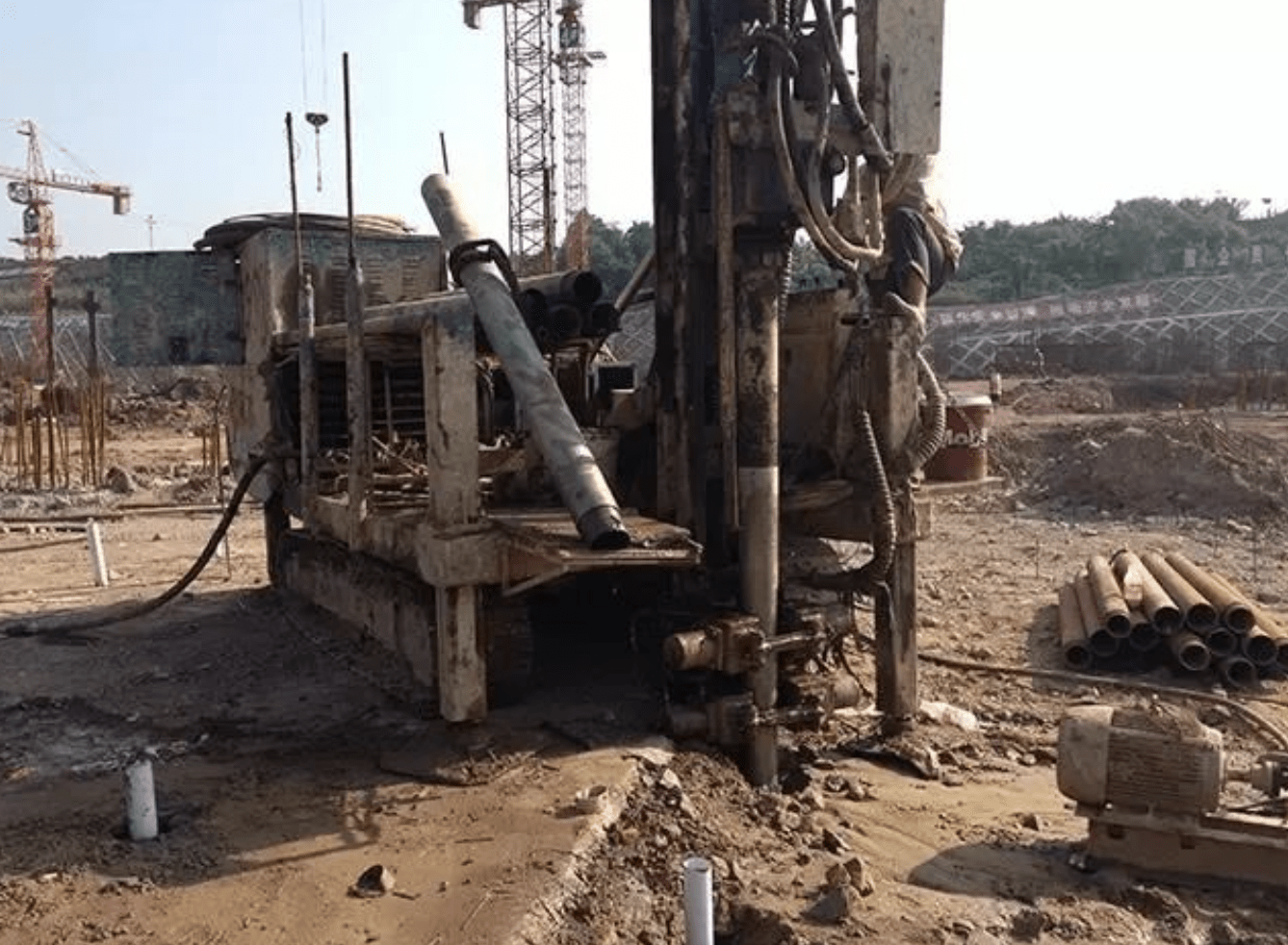
Introduction to High-Pressure Jet Grouting
High-pressure jet grouting is an advanced ground improvement technique that involves drilling a grouting pipe with a nozzle into the soil to a predetermined depth. A high-pressure pump then forces grout (or water/air) through the nozzle at 20–40 MPa, creating a high-velocity jet that cuts, disturbs, and breaks down the soil. As the drill rod is gradually lifted, the grout mixes thoroughly with soil particles, forming a cylindrical solidified column (known as a jet grouted pile) upon hardening. This method is widely used for foundation reinforcement and waterproofing.
Jet Grouting Methods
Depending on the injection technique, jet grouting can be classified into three main methods:
1. Single-Fluid System (Single-Tube Method)
-
Uses a single injection pipe to deliver cement grout only.
2. Double-Fluid System (Dual-Tube Method)
-
Utilizes a dual-tube system to simultaneously inject high-pressure cement grout and compressed air.
-
The combined action of the grout and surrounding air jet significantly enhances soil disruption, resulting in a larger stabilized column.
3. Triple-Fluid System (Triple-Tube Method)
-
Employs three separate tubes to deliver water, air, and grout.
-
High-pressure water surrounded by an air jet cuts and loosens the soil, creating a larger void.
-
Lower-pressure grout is then injected to mix with the fragmented soil, forming a solidified column with a diameter of up to 2 meters.
Factors Affecting Jet Grouting Efficiency
The radius of soil stabilization depends on several factors:
-
Directly proportional: Nozzle diameter (d) and injection pressure (P).
-
Inversely proportional: Lifting speed (S), soil shear strength (τ), and grout viscosity (B).
The strength of the stabilized soil depends on:
-
Cement content per unit volume.
-
Soil properties.
Jet Grouting Mechanism
The formation of jet grouted piles involves five key processes:
-
Soil Cutting & Disruption: High-pressure jets break down soil structure, creating cavities and expanding fissures.
-
Mixing & Blending: The rotating drill rod forces soil particles to mix with grout, forming a homogenous matrix.
-
Soil Replacement (Triple-Fluid Method): Compressed air expels fragmented soil particles, which are then replaced by grout.
-
Infiltration & Solidification: Grout fills voids and permeates sandy layers, hardening into a solid mass.
-
Compaction Effect: Residual pressure at the jet periphery compacts surrounding soil, increasing strength at the column edges.
Construction Process & Key Steps
1. Pre-Construction Preparations
-
Conduct supplementary geotechnical investigations.
-
Ensure sufficient cement and water supply (pH 5–10).
-
Perform lab mix design tests to determine optimal water-cement ratio (1.0–1.5) and admixtures (e.g., accelerators, plasticizers).
-
Conduct trial piles to refine lifting speed, rotation rate, and grout pressure.
-
Clear and level the site, set up drainage, and mark pile locations.
2. Construction Steps
-
Drill Positioning: Align the drill vertically (≤1–1.5% deviation).
-
Grout Preparation: Mix cement, water, and additives; filter through 0.8mm sieves.
-
Drilling (Triple-Fluid Method): Pre-drill to design depth (150mm diameter).
-
Pipe Insertion (Single/Dual-Tube Methods): Use vibration or low-pressure jets to prevent nozzle clogging.
-
Lifting & Mixing: After reaching depth, apply full pressure (20–40 MPa) and lift at a controlled rate.
-
Pile Head Treatment: Slow lifting near the top (1m below cutoff) to ensure integrity.
-
Gravelly Soil Treatment: Repeat grouting if necessary to ensure the diameter.
-
Equipment Cleaning: Flush all lines post-operation.
-
Backfilling: Address shrinkage cracks with 1.0 water-cement ratio grout.
3. Recommended Technical Parameters
| Method | Grout Pressure (MPa) | Air Pressure (MPa) | Water Pressure (MPa) | Lifting Speed (m/min) |
|---|---|---|---|---|
| Single-Tube | 20–40 | – | – | 0.2–0.25 |
| Dual-Tube | 20–40 | 0.7–0.8 | – | – |
| Triple-Tube | 0.2–0.8 | 0.5–0.8 | 30–50 | – |
Quality Control & Common Issues
1. Quality Standards
-
Ensure verticality, diameter, and strength meet specifications.
2. Key Control Measures
-
Optimize parameters via trial piles.
-
Maintain grout volume loss <20%; adjust if excessive.
-
Ensure continuous rotation/lifting to prevent voids.
-
Use fresh cement and strict water-cement ratios.
3. Troubleshooting
-
Low Grout Return: Increase viscosity, add sand, or use sealing agents.
-
Excessive Grout Return: Raise pressure, reduce nozzle size, or accelerate lifting.
-
Surface Craters: Perform secondary grouting with expansive mixes.
Safety & Environmental Considerations
Safety Measures
-
Regular equipment checks (pumps, hoses, safety valves).
-
Maintain a 60cm minimum distance from active nozzles.
-
Handle chemicals cautiously; rinse eyes immediately if exposed.
Environmental Protection
-
Cover cement storage to prevent dust.
-
Implement noise and dust suppression.
-
Properly dispose of waste grout.
Conclusion
High-pressure jet grouting is a versatile solution for soil stabilization and waterproofing. By optimizing parameters, ensuring strict quality control, and adhering to safety protocols, contractors can achieve durable, high-performance foundations. Proper execution of single, dual, and triple-fluid systems ensures efficient ground improvement across diverse soil conditions.