
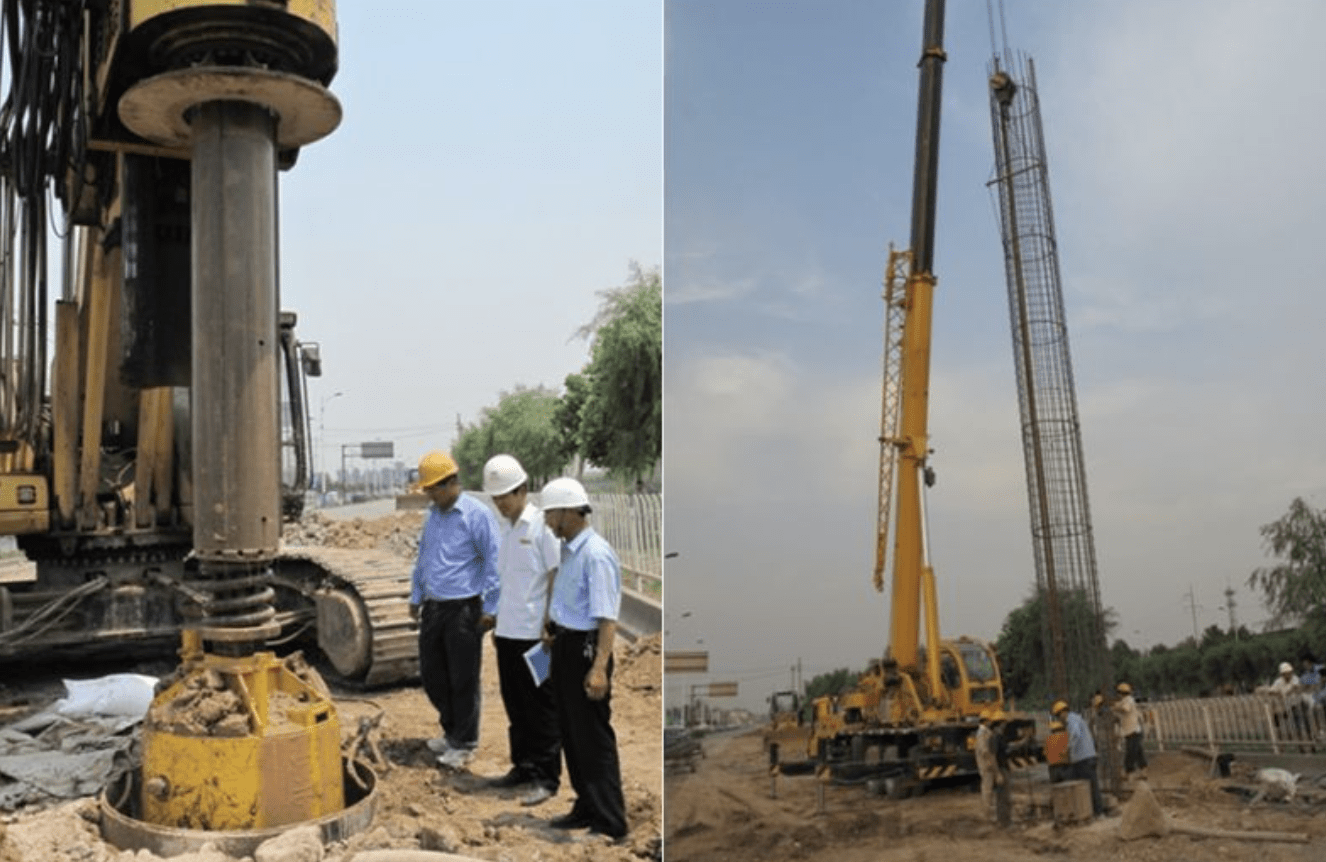
Overview of Pile Foundations
Composition and Key Features
Pile foundations consist of pile groups and pile caps, offering several advantages:
-
High bearing capacity with minimal settlement
-
Excellent stability
-
Reduced need for extensive excavation, minimizing dewatering and support requirements
However, they also present challenges:
-
Complex construction process
-
Higher costs compared to shallow foundations
Applications
Pile foundations are suitable for:
-
Heavy loads on thick, weak soil layers
-
Areas with significant riverbed scouring
-
Projects requiring strict settlement control
-
Structures subjected to large horizontal loads
-
Locations with high water tables
-
Seismic zones requiring liquefaction resistance
Classification of Piles and Pile Foundations
By Material
-
Timber piles (rarely used today)
-
Concrete piles (less common)
-
Reinforced concrete piles (most widely used)
-
Steel piles (higher cost)
By Construction Method (Reinforced Concrete Piles)
Prefabricated Piles
-
Installation methods: Driving, vibrating, or pressing
-
Advantages:
-
Consistent quality control
-
Suitable for marine construction
-
High construction efficiency
-
-
Disadvantages:
-
Higher unit cost than cast-in-place piles
-
Noise pollution from hammering/vibration
-
Soil displacement may cause ground heaving
-
Weakness at pile joints
-
Difficulty penetrating hard strata
-
Cast-in-Place Piles (Bored Piles)
-
Installation methods: Drilling, impact drilling, pipe sinking, or manual excavation
-
Advantages:
-
Adaptable to various soil conditions
-
Capable of large diameters for higher load capacity
-
More economical (less steel reinforcement required)
-
-
Disadvantages:
-
Quality control challenges
-
Sediment accumulation at the pile base (except for manually excavated piles)
-
Limited suitability for underwater construction
-
Pipe Pile Foundations
-
Installation: Precast concrete pipes are sunk, drilled internally, and filled with reinforced concrete.
-
Features: High load-bearing capacity, ideal for deep-water construction.
By Orientation
-
Vertical piles: Standard load-bearing piles
-
Battered (inclined) piles: Resist lateral forces
By Soil Displacement Effect
-
Displacement piles: Solid precast piles, closed-end pipe piles
-
Partial displacement piles: Impact-drilled piles, steel piles
-
Non-displacement piles: Bored (drilled) piles
By Axial Load Transfer Mechanism
-
Friction piles: Primarily resist loads through side friction
-
End-bearing piles: Resist loads through base resistance
-
Combination piles: Utilize both friction and end-bearing
Industry standards (railway, highway, and building codes) define these classifications differently based on load distribution ratios.
Design and Calculation Principles
Key Design Considerations
-
Pile type (construction method)
-
Material selection
-
Pile cap elevation
-
Number and layout of piles
-
Reinforcement design for piles and caps
Verification Requirements
-
Single pile axial capacity (geotechnical resistance)
-
Pile material strength
-
Overall foundation bearing capacity
-
Settlement analysis
-
Lateral displacement at the pier top
-
Pile cap strength
Single Pile Axial Capacity
Load Transfer Mechanism
-
Axial load is distributed between side friction and base resistance
-
General behavior:
-
Side friction mobilizes before base resistance
-
Ultimate side friction is reached before base resistance
-
Required displacement for full base resistance exceeds side friction activation
-
Load distribution depends on the length-to-diameter ratio and soil stiffness
-
Negative Skin Friction
-
Occurs when the surrounding soil settles more than the pile
-
Causes:
-
Large-scale dewatering
-
Surface surcharge loads
-
Newly filled or under-consolidated soils
-
Collapsible loess or thawing permafrost
-
-
Mitigation: Soil improvement or pile-soil isolation techniques
Failure Modes
-
Buckling failure (slender piles, rock-socketed piles, ultra-long piles)
-
General shear failure (driven short piles)
-
Punching failure (bored piles)
Bearing Capacity Determination
-
Static load testing
-
Ultimate capacity is derived from load-settlement curves
-
Acceptance criteria vary based on test result consistency
-
-
Empirical methods (for friction and end-bearing piles)
-
Uplift capacity evaluation (for tension-resistant piles)
Allowable Stress Verification
-
Friction piles: Geotechnical resistance governs
-
End-bearing piles: Material strength governs
-
Safety factors adjust for different load combinations