Leakage and Sand Boiling
1) Phenomenon:
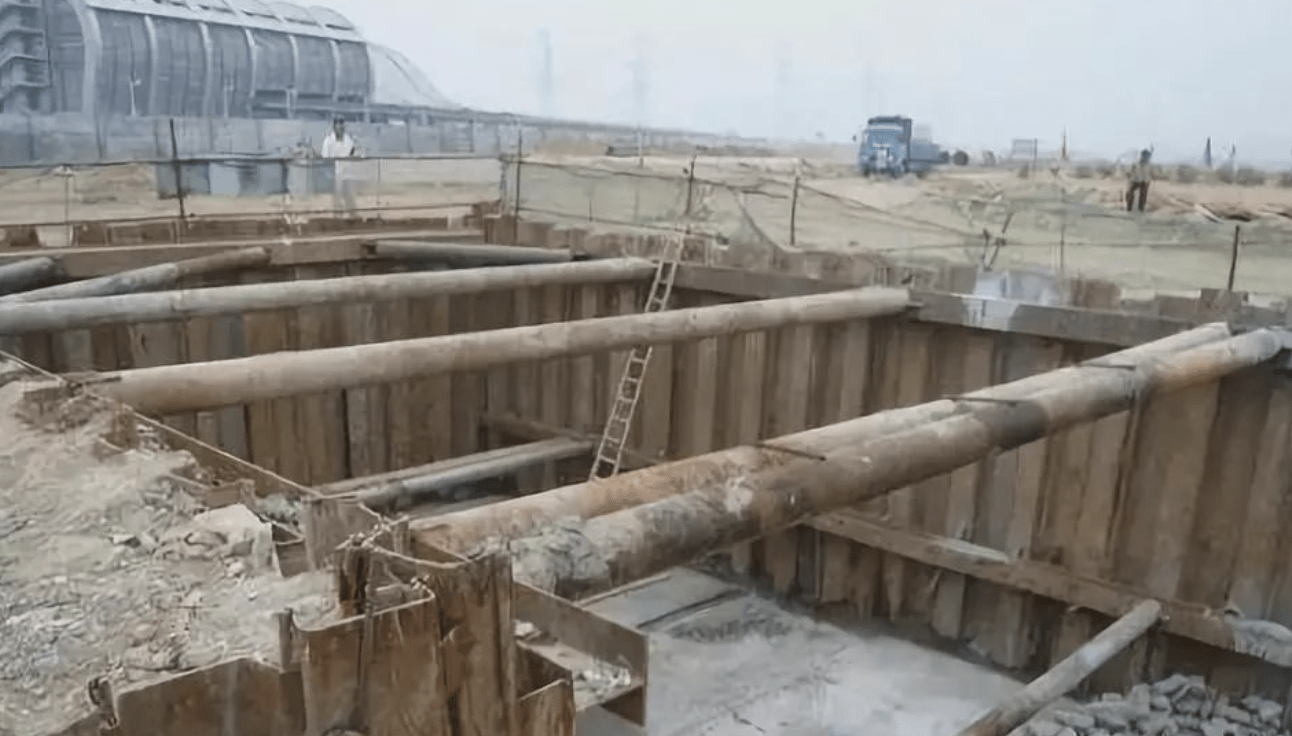
During excavation, leakage is observed at steel sheet pile joints and corners, sometimes accompanied by sand boiling.
2) Cause Analysis:
-
A. Old or poorly maintained Larssen sheet piles may have misaligned interlocks, leading to water seepage.
-
B. Corner piles, often cut and welded for closure, may deform, compromising watertightness.
-
C. Improper interlock alignment during installation creates gaps.
-
D. Excessive vertical deviation in piles causes interlock leakage.
3) Preventive Measures:
-
Correct old piles using hydraulic jacks or heat straightening before installation.
-
Use guide frames to ensure vertical driving and alignment.
-
Install clamping plates to prevent interlock displacement.
-
For closure difficulties:
-
Use specially shaped corner piles (challenging).
-
Apply the axis closure method (preferred).
-
Steel Sheet Pile Tilting
1) Phenomenon:
Excavation near piles causes tilting, ground cracks, and base heaving.
2) Cause Analysis:
-
A. In soft soil, insufficient embedded depth leads to ground settlement and heaving (piping effect).
-
B. Heavy equipment near piles increases lateral soil pressure.
3) Solutions:
-
Calculate required embedment depth per JGJ 120—1999 Technical Specification for Retaining and Protection of Building Foundation Excavations.
-
Prohibit heavy machinery near unsupported excavation edges. If unavoidable, include loads in design calculations.
-
Combine with compaction grouting at the base for waterproofing (thickness varies with soil type).
-
Grout corner joints (3–4 injections) to prevent sand flow.
-
Use well-point dewatering for high water tables.
Pile “Drag-Down” (Co-Sinking)
1) Phenomenon:
Newly driven piles cause adjacent installed piles to sink.
2) Cause Analysis:
Bent or tilted piles increase interlock friction, pulling neighboring piles deeper.
3) Solutions:
-
Correct tilt immediately during driving.
-
Weld temporary angle braces to stabilize affected piles.
Quality Control Standards
-
Material Compliance: Piles must meet design and manufacturer specifications.
-
Installation Accuracy:
-
Elevation and joint treatments per design.
-
Installation/removal aligned with design load conditions.
-
-
Tolerances:
-
Position deviation: ≤50mm (both axes).
-
Verticality: ≤0.5%.
-
Elevation: ±30mm.
-
Piles must fit tightly against soil.
-