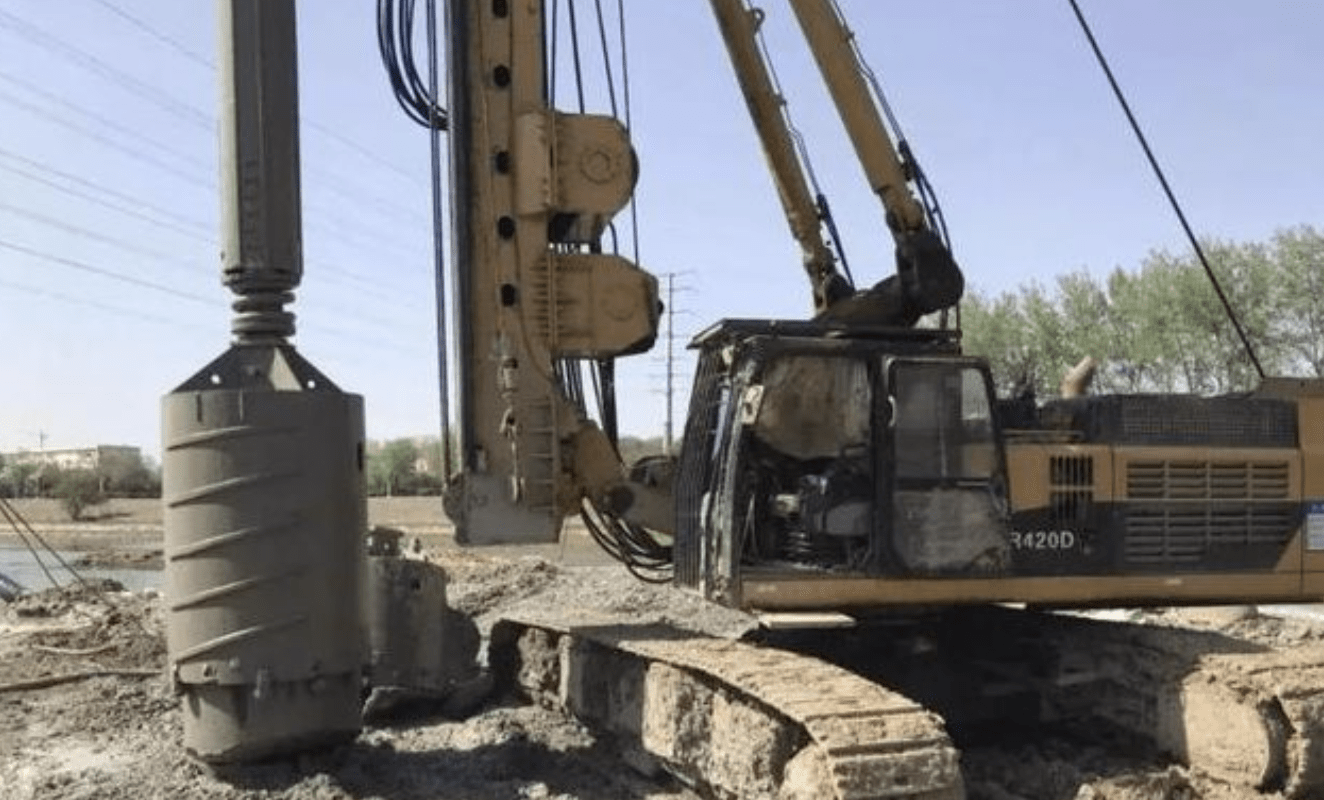
The crawler undercarriage serves as the primary supporting and walking component of a rotary drilling rig with a mechanical locking rod system. It ranks as one of the most critical parts of the rig, second only to the engine and hydraulic system. Numerous factors influence the performance of the crawler undercarriage in engineering drilling rigs. Inadequate consideration or poor design can lead to issues such as difficulty walking and steering, poor acceleration, and reduced efficiency. Below, we analyze the key factors that affect the performance of crawler undercarriages in drilling rigs.
1. External Ground Resistance on the Crawler Track
External ground resistance refers to the operational resistance caused by ground deformation. Its magnitude depends on factors such as ground contact pressure, the position of the vehicle’s center of gravity, and ground conditions. Since engineering drilling rigs typically operate in harsh environments, it is essential to carefully select the running resistance coefficient, taking into account various working conditions to ensure optimal performance.
2. Internal Resistance
Internal resistance primarily consists of the frictional forces generated within the walking mechanism. A standard crawler undercarriage includes components such as the driving mechanism, track chain, carrier rollers, guide wheels, track rollers, or track support plates. During operation, friction between these components inevitably creates internal resistance, which can be categorized into five main types:
-
(1) Friction Resistance in Track Pins and Bushings
This occurs when the track plates bend around the guide wheel and drive sprocket, causing relative rotation between the track pins and bushings. The resistance depends on the pin diameter and the friction coefficient between the pins and bushings. -
(2) Friction Resistance at Carrier Rollers
This resistance is influenced by the outer diameter of the carrier rollers, the diameter of the roller wheel, the load transmitted to the track plates, and the friction coefficient of the roller axle. -
(3) Friction Resistance at Guide Wheels
This resistance is determined by the friction coefficient between the guide wheel and its bearings, the diameter of the guide wheel axle, and the diameter of the guide wheel raceway. -
(4) Friction Resistance at Drive Sprockets
This type of resistance depends on the friction coefficient of the drive sprocket bearings, the diameter of the drive sprocket axle, the pitch circle diameter of the sprocket, and the tension in the track chain. -
(5) Friction Resistance at Track Rollers or Support Plates
This resistance is mainly affected by the weight of the track plates supported by the rollers or support plates, the contact area, and the friction coefficient.
To ensure optimal performance of the mechanical locking rod rotary drilling rig, it is crucial to minimize internal resistance during the selection and assembly of the undercarriage components. Proper matching of parts can reduce unnecessary frictional losses, enhancing the machine’s overall efficiency and operational stability.
Key Takeaways for Optimal Crawler Undercarriage Performance
-
Select appropriate ground resistance coefficients based on working conditions.
-
Minimize internal friction through proper component selection and assembly.
-
Ensure balanced load distribution to reduce excessive wear and resistance.
By addressing these factors, operators can enhance the durability, efficiency, and performance of their drilling rigs’ crawler undercarriages, leading to smoother operations and reduced maintenance costs.