
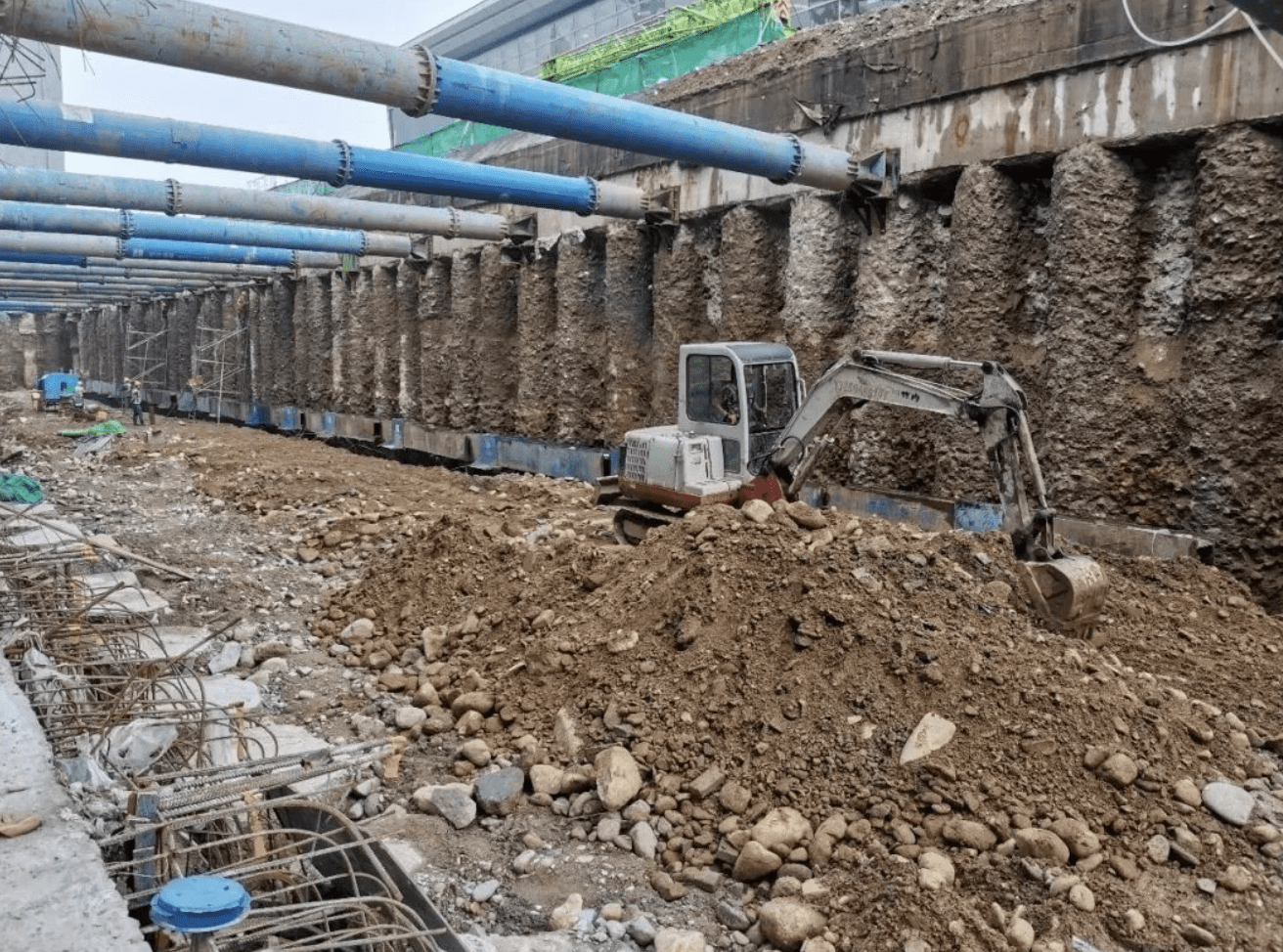
Introduction to Foundation Pit Support Engineering
Foundation pit support engineering refers to the structural measures taken during excavation to ensure slope stability, protect the safety of underground construction, and prevent damage to the surrounding environment. The selection of an appropriate support method depends on factors such as:
-
Excavation depth
-
Site conditions
-
Surrounding environment (adjacent structures, roads, pipelines)
-
Hydrogeological conditions
-
Project schedule requirements
Cost Comparison of Common Support Methods (Low to High):
Slope excavation < Soil nail wall (composite soil nail wall) < Cement-soil gravity retaining wall < SMW method (steel-reinforced mixing wall) < Soldier pile wall < Diaphragm wall
1. Slope Excavation
Slope excavation is the most economical method when space permits.
Key Technical Requirements:
-
Slope ratio should be determined based on soil properties and excavation depth.
-
For excavations deeper than 4m, multi-level slopes with intermediate platforms are required.
-
In stable soil conditions, natural slopes are preferred.
-
In soft soil areas, slope surfaces should be reinforced with steel mesh and shotcrete.
Groundwater Control:
-
If excavation occurs below the water table, dewatering wells must be installed.
-
Drainage ditches or water barriers should prevent surface water infiltration.
-
If deep pits exist near the slope toe, maintain a distance of at least 2x the pit depth; otherwise, slope stability must be recalculated.
2. Soil Nail Wall (Composite Soil Nail Wall)
Used when space constraints prevent full slope excavation.
Construction Details:
-
Soil nail types: Steel pipe nails or reinforced bars with shotcrete facing.
-
Drainage: Install weep holes in water-bearing layers to reduce hydrostatic pressure.
-
Prestressed anchor composite walls:
-
Use steel strand anchors in the upper sections.
-
Anchors should be placed in high-pressure or weak soil zones.
-
3. Cement-Soil Gravity Retaining Wall
A cost-effective solution for moderate-depth excavations.
Design Principles:
-
Constructed using double or triple-axis mixing piles (150–200mm overlap).
-
A concrete cap is recommended for enhanced stability.
-
Pile selection:
-
For depths <16m, double-axis piles are preferable.
-
For depths >16m or soft soils (e.g., silt), triple-axis piles with higher cement ratios are used.
-
-
Grid layout: Optimized to improve structural integrity (see typical double-axis layout).
4. Steel-Reinforced Mixing Wall (SMW Method)
Combines soil mixing piles with H-shaped steel sections for strength and water retention.
Implementation Guidelines:
-
Pile construction: Use overlapping (“interlocked”) piles for watertightness.
-
Steel sections: Common types include H400×400, H500×200, H700×300, and H800×300.
-
Rental periods should not exceed 6 months for cost efficiency.
-
Layout options: “Skip-one,” “skip-two,” or dense arrangements for varying stiffness.
-
-
Friction reduction: Coat steel sections to facilitate post-construction extraction.
5. Soldier Pile Wall with Waterproof Curtain
Ideal for deep excavations requiring groundwater control.
Critical Considerations:
-
Waterproofing: Install cutoff walls (double/triple-axis piles) outside the piles.
-
For depths <16m, double-axis piles suffice.
-
For deeper excavations or sandy layers, triple-axis piles are mandatory.
-
-
Curtain depth:
-
In cohesive soils, extend 6–7m below the base.
-
For permeable layers (sand, silt), fully penetrate the aquifer.
-
-
“Pile-Wall Integration”: Reuse temporary piles as permanent structural walls to reduce material waste and costs.
6. Diaphragm Wall (“Two-Wall Integration”)
The optimal choice for deep basements (3+ levels) in soft soil regions.
Construction Features:
-
Dual function: Serves as both temporary support and permanent basement wall.
-
Standard thicknesses: 600mm, 800mm, 1000mm, and 1200mm.
-
Guide walls: Essential for maintaining alignment during trenching.
-
Pre-reinforcement: Use cement-soil mixing piles in sandy/silty layers to prevent slurry loss.
-
Joint waterproofing: High-pressure jet grouting between panels, supplemented by drainage systems.
Conclusion
Selecting the right foundation pit support system requires balancing technical feasibility, environmental impact, and budget. This guide outlines industry-standard practices to ensure safety, efficiency, and cost-effectiveness in underground construction.