
Introduction
Lime soil compaction piles are widely used to eliminate the collapsibility of loess foundations, making them suitable for treating collapsible loess, plain fill, and miscellaneous fill foundations above the groundwater level. With an optimal treatment depth of 5-15 meters, this method is one of the most common techniques for stabilizing loess foundations and has been extensively applied in northwest and north China.
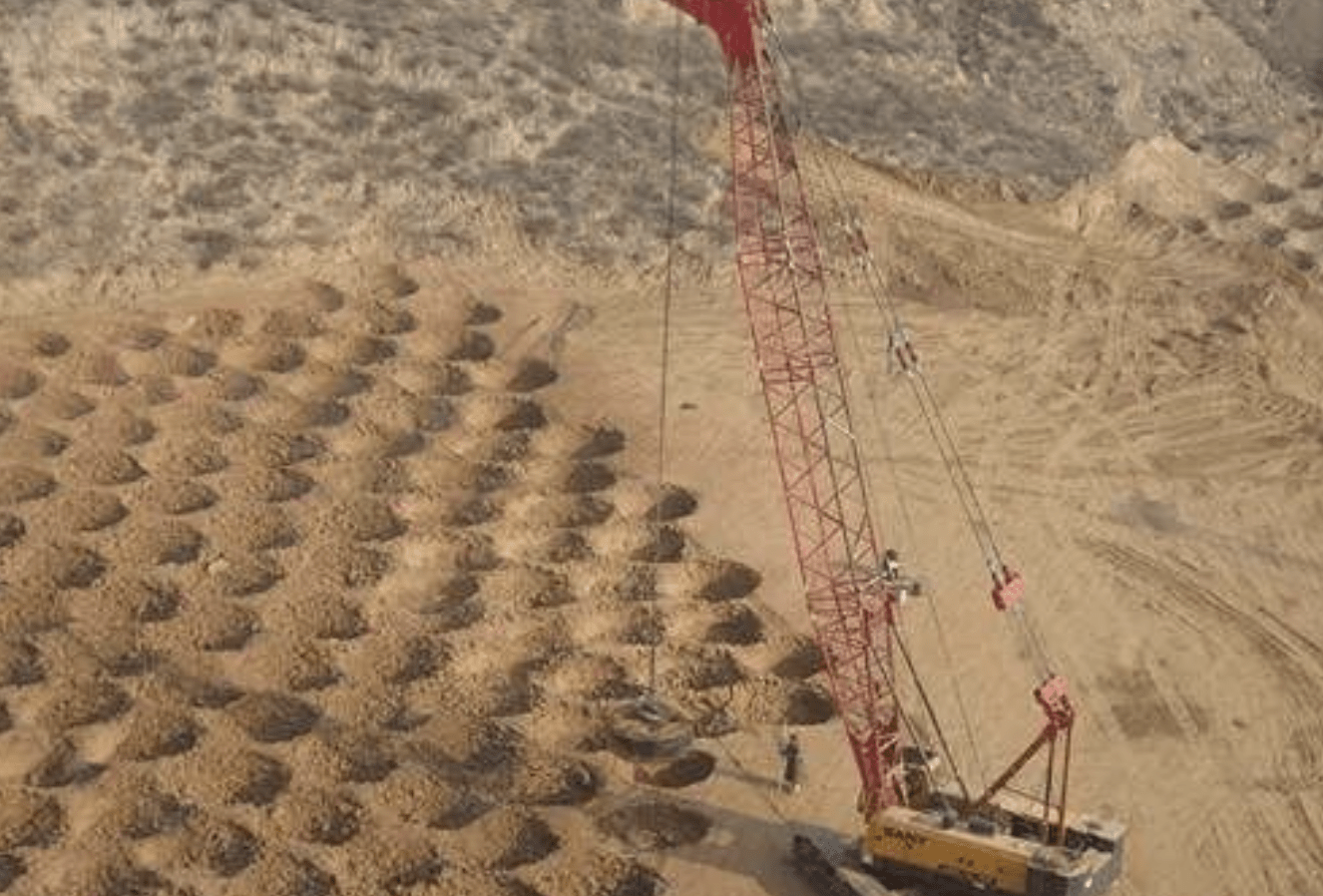
The lime soil compaction pile method involves using a diesel hammer pile driver to form holes by impact-driven tube compaction. The surrounding soil is densified, and lime-soil mixture is filled into the holes in layers to form compacted lime-soil piles, creating a composite foundation with the surrounding soil.
Pre-Construction Preparations
1. Material Requirements
-
Soil Material:
-
Use plain loess or silty soil with a plasticity index greater than 4.
-
Organic content must be less than 5%; cultivated soil is prohibited.
-
Soil must be sieved, with particle size not exceeding 15mm.
-
-
Lime:
-
Fresh quicklime must be used, slaked, and sieved 7 days before application.
-
No unhydrated lime particles or impurities are allowed; particle size ≤ 5mm.
-
Lime quality must meet Grade II standards, with active CaO + MgO content ≥ 60%.
-
-
Mixing:
-
Conduct lab tests to determine maximum dry density and optimal moisture content.
-
Use centralized mixing equipment for uniform consistency.
-
Maintain moisture content within ±2% of the optimal level during compaction.
-
2. Key Equipment
-
Hole-forming machinery
-
Lime-soil mixer
-
Compaction hammer (≥ 1.5 tons)
3. Site Preparation
-
Level the construction site and pre-compact soft areas for machine stability.
-
Ensure proper drainage with temporary trenches.
-
Set and verify control axes, benchmarks, and pile locations (marked with pegs or lime).
Lime Soil Compaction Pile Construction
1. Trial Pile Testing
-
Conduct test pile construction before full-scale work to determine key parameters:
-
Compaction density
-
Hammer drop height
-
Number of blows per layer
-
Filling thickness per layer
-
-
Design typically requires a pile compaction density of≥ 93%.
2. Construction Sequence
-
Follow an inside-out, skip-row approach to prevent soil disturbance.
3. Process Flow
-
Site leveling
-
Marking pile positions
-
Machine positioning
-
Hole formation
-
Filling and compaction
-
Quality inspection
4. Hole Formation
-
Use a long spiral drill for hole formation.
-
Ensure vertical alignment (deviation ≤ 1.5% of pile length).
-
Avoid drilling when soil moisture is> 20% to prevent hole shrinkage.
-
Re-drill if machine movement causes hole collapse.
5. Lime-Soil Mixing
-
Sieve soil and lime separately before mixing.
-
Use freshly mixed lime-soil on the same day.
-
Test lime content and moisture daily.
6. Compaction Process
-
Pre-compact the hole bottom with 2–3 hammer blows.
-
Fill in 400–500mm layers at optimal moisture content.
-
Use symmetrical filling to avoid pile deviation.
-
Lift hammer ≥ 3m, apply ≥ 6 blows per layer.
-
Repeat until reaching design elevation.
7. Quality Control
-
Test compaction density at specified intervals.
-
Verify bearing capacity and soil densification post-construction.
Key Construction Considerations
Compaction Guidelines
-
Maintain hammer alignment to ensure free fall into the hole.
-
Follow skip-row sequencing to prevent water infiltration.
-
Pre-compact hole bottoms (3–4 blows) before filling.
-
Adjust hammer blows if compaction is insufficient.
-
Match material usage with calculated quantities.
Quality Assurance Measures
-
Adhere to industry standards and specifications.
-
Conduct thorough inspections and daily progress reviews.
-
Assign supervisors for hole formation, filling, and compaction.
-
Implement step-by-step approval between phases.
-
Maintain detailed records (hidden works logs, compaction reports).
-
Test ≥ 2% of piles via ring-sampling for compaction/densification checks.
Safety Protocols
-
Mandatory safety training and helmet use.
-
Secure pile machines to prevent tipping/hammer accidents.
-
Keep a 6m clearance during drilling.
-
Cover unused holes to prevent falls.
-
Inspect electrical equipment before compaction.
-
Avoid overnight open holes; implement rain protection.
Schedule & Environmental Controls
1. Timeline
-
Target 80–100 piles per shift (07:00–22:00).
2. Eco-Friendly Practices
-
Noise Control: Restrict pile driving to daytime; use noise barriers.
-
Dust Management: Cover transport vehicles; clean wheels before exit.
-
Oil Spill Prevention: Regular machinery checks; proper waste disposal.
-
Site Cleanliness: Wash trucks and maintain gate hygiene.
Conclusion
Lime soil compaction piles offer a reliable solution for stabilizing collapsible loess foundations. By following strict material, compaction, and safety protocols, contractors can ensure high-quality, durable results while meeting environmental and scheduling demands. Proper execution enhances foundation integrity, making this method indispensable in loess regions.