
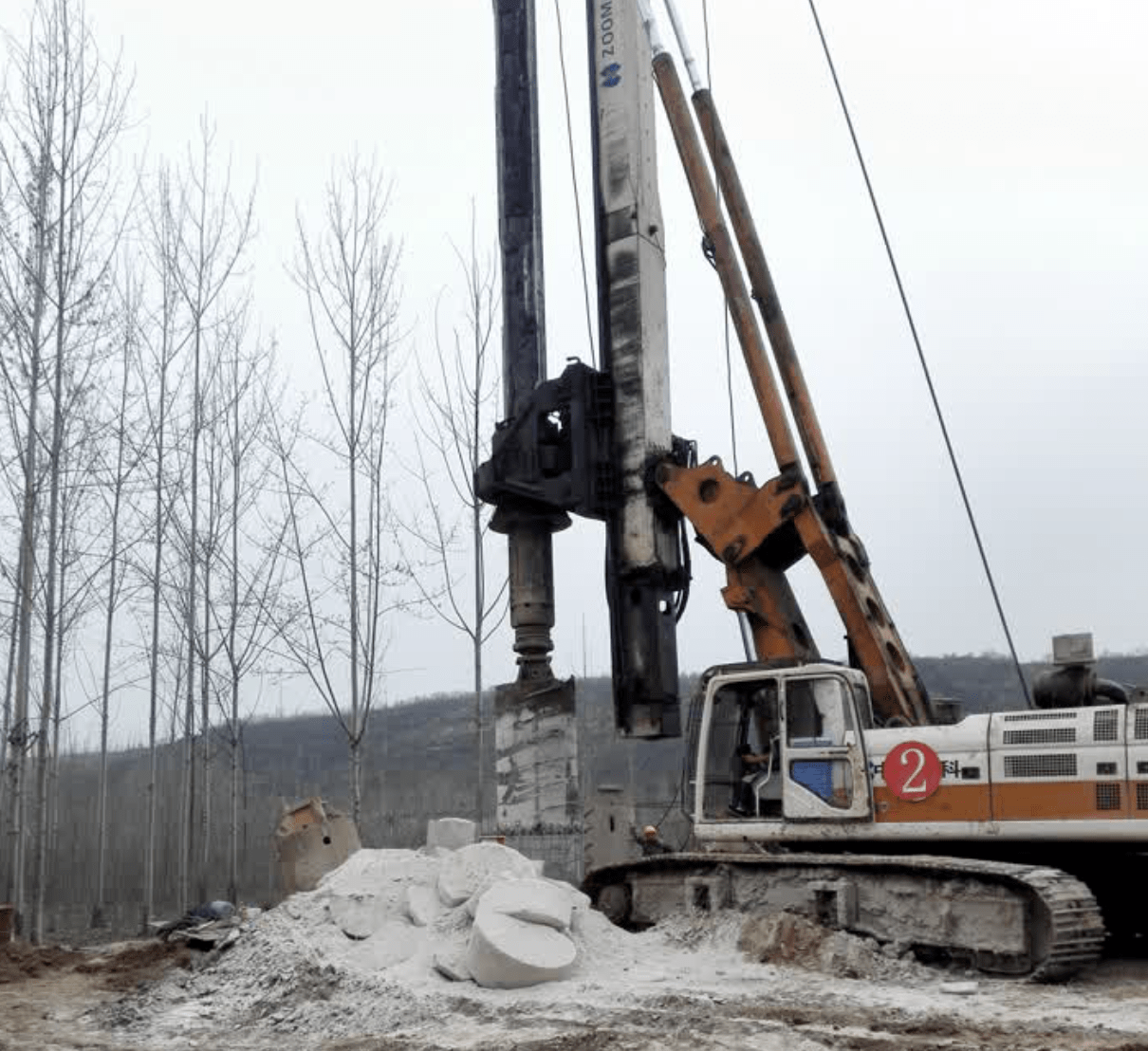
Introduction to Rock Socketed Piles
Rock socketed piles are commonly installed using impact drilling methods. However, due to practical construction limitations, as well as environmental and civil engineering requirements, impact drilling is often restricted. With the rise of large-scale bridge construction projects, especially those involving ultra-deep piles, alternative methods such as high-power rotary drilling rigs have gained prominence. These rigs, known for their efficiency, mobility, environmental benefits, and adaptability to various soil conditions, are widely used in highway bridges, railways, municipal projects, and hydraulic engineering.
The core of high-power rotary drilling for rock socketed piles lies in the use of alloy drill bits and the appropriate drilling technique. This article provides insights into these methods and their advantages, offering useful references for similar projects.
Limitations of Traditional Construction Methods
1. Impact Drilling Issues
When impact drilling is used for rock socketed pile construction, challenges such as hole deviation are common. For instance, during the construction of the Zhengjiahe Bridge’s main pier (Pile 11), the site encountered medium-weathered sandstone with a maximum strength of 83.9 MPa. The pile diameter was 2.6 meters, with a pile length of 48 meters and a maximum rock penetration depth of 45 meters. Using a high-power rotary drilling rig, a pile could be completed every three days without requiring slurry preparation. In contrast, impact drilling would allow only a drilling depth of 1.5 to 2 meters per day, resulting in a completion time of approximately 20 to 24 days per pile. Therefore, high-power rotary drilling significantly reduces pile construction time by 17 to 21 days, minimizes the risk of hole collapse, and eliminates issues like stuck drill bits or hole deviation.
2. Environmental Concerns and High Costs
Impact drilling often requires the preparation of large amounts of slurry. For the Zhengjiahe Bridge project, around 280 cubic meters of slurry were needed for a single pile. Without proper slurry pit protection, slurry leakage can contaminate nearby rivers. Additionally, slurry pits, which need to be regularly maintained, pose a safety risk. The project site is located near a national tourist attraction, Lin’gao Lake, making improper slurry disposal a significant environmental concern.
In terms of cost, using rotary drilling is more efficient. For example, in the Zhengjiahe Bridge project, the high-power rotary drilling rig can complete a pile in three days without slurry preparation, compared to the 20-24 days required by impact drilling. Moreover, impact drilling incurs additional costs for slurry preparation, pit construction, and labor, amounting to around 12,000 yuan per pile. The overall cost savings of using rotary drilling in this context amounts to approximately 49,200 yuan per pile.
Improved Construction Methods
1. Drilling Method Optimization
For a pile diameter of 2.6 meters, three different construction methods were proposed for rotary drilling:
-
Option 1: Start with a 1.25-meter alloy drill bit for core removal. After drilling 10 meters, switch to a 1.8-meter drill bit to expand the hole to the required elevation. Finally, use a 2.6-meter drill bit to complete the hole.
-
Option 2: Begin with a 1.8-meter alloy drill bit for core removal, then switch to a 2.6-meter drill bit after drilling 10 meters.
-
Option 3: Use a 1.25-meter drill bit to create a triangular-shaped hole for the first 10 meters, then switch to a 2.6-meter drill bit for the final hole.
2. Optimized Drilling Process
The most effective method involves using a 460 kW high-power rotary drilling rig equipped with a high-strength alloy drill bit. In this method, the initial drilling is done with a 1.25-meter bit for core removal. After drilling 10 meters, the hole is expanded using a 1.8-meter drill bit, and after reaching the required depth, the hole is completed with a 2.6-meter drill bit. This optimized approach allows for a drilling speed of up to 6.5 meters per day, greatly improving efficiency.
Conclusion: High-Power Rotary Drilling for Efficient Rock Socketed Piles
The high-power rotary drilling method for rock socketed piles offers several advantages over traditional impact drilling methods. These benefits include faster construction time, reduced environmental impact, and cost savings. For large-scale projects like the Zhengjiahe Bridge, the adoption of this technology can significantly enhance project efficiency and quality. Furthermore, the growing demand for deep and large-scale pile foundations in modern construction makes high-power rotary drilling an essential tool for future engineering projects.
The continuous development of rotary drilling technology ensures that it remains a cost-effective and reliable choice for constructing rock socketed piles, especially in challenging soil conditions.