
Introduction
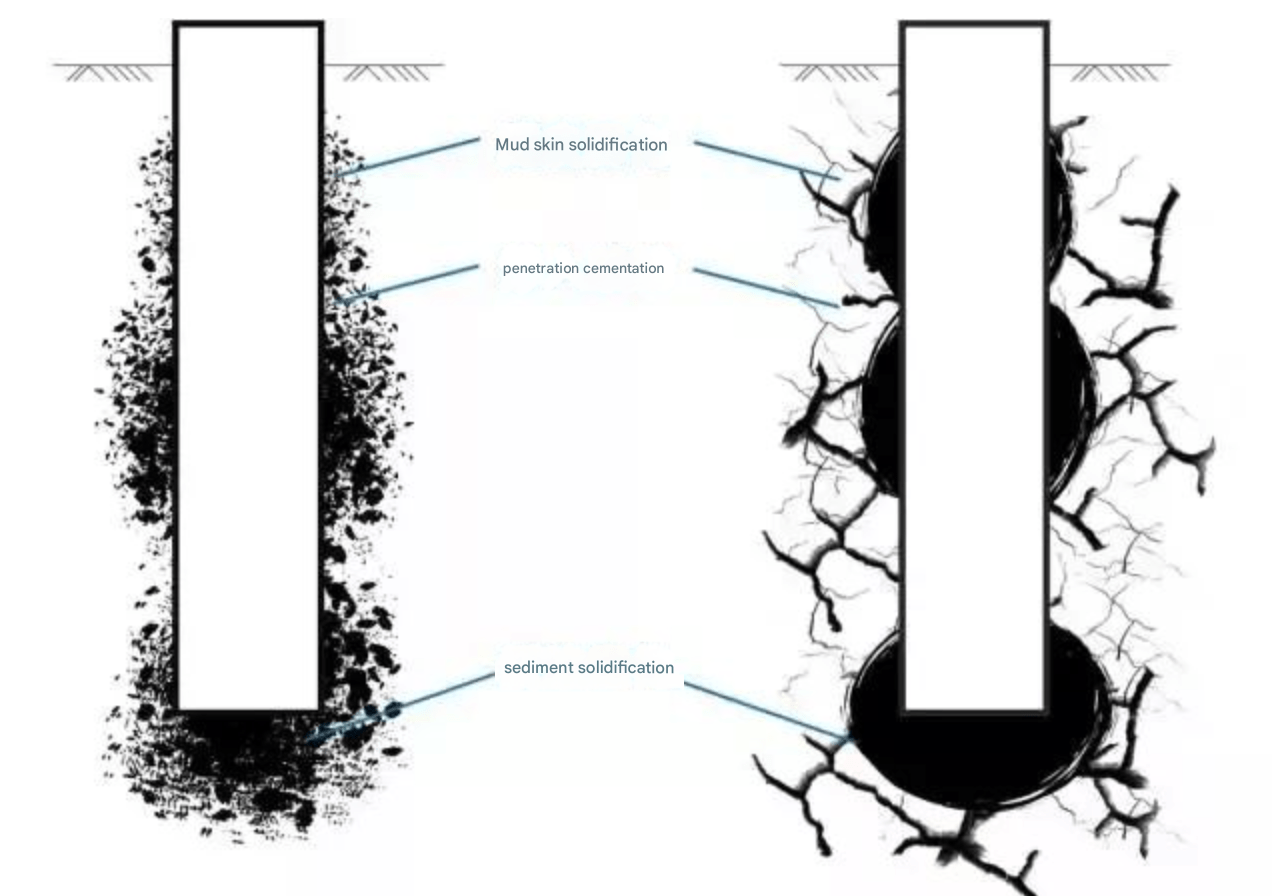
With the large-scale development of high-rise buildings and increasing environmental protection requirements in urban areas, bored piles have become increasingly popular as foundation piles in construction projects. Bored piles offer advantages such as adaptability to various geological conditions, flexible pile diameter and length adjustments, and low noise and vibration. However, traditional construction methods often result in quality inconsistencies, unstable single-pile bearing capacity, and higher costs due to factors like sediment accumulation at the pile bottom, slurry skin on the pile side, soil relaxation, and rebound of the bearing stratum.
To improve single-pile bearing capacity, reduce construction costs, and minimize quality variations, post-grouting technology for bored piles has been widely adopted. This technique significantly enhances the load-bearing capacity of bored piles and reduces foundation settlement, gaining broad recognition in the industry. It is particularly effective in regions with porous, highly permeable soft soil or gravel layers, such as Taizhou, Zhejiang, where it substantially increases pile strength.
This article presents a case study of the Beijing Normal University Taizhou Experimental School project, where Qiancheng Construction Group implemented Engineering, Procurement, and Construction (EPC) services, utilizing post-grouting technology for bored piles.
Technology Overview and Principles
Post-grouting for bored piles involves injecting cement slurry under high pressure through pre-installed grouting pipes after the pile concrete reaches a predetermined strength. The grout permeates loose soil around the pile tip, forming high-strength concrete. As grouting continues, the slurry infiltrates the softened bearing stratum, increasing the load-bearing area and effectively enlarging the pile base.
When the surrounding dense soil restricts further penetration, pressure builds up, compacting and reinforcing the pile tip stratum. This process strengthens the sediment and disturbed bearing layer, enhances soil-pile interaction, and improves the surrounding soil’s load-bearing capacity, thereby increasing single-pile bearing capacity and reducing settlement.

Construction Process and Key Points
-
Bored Pile Construction →
-
Installation of Grouting Pipes in Reinforcement Cage →
-
Cleaning Grouting Pipes with Water Within 12 Hours After Concrete Pouring →
-
Initiating Grouting After 7 Days for Uniform Soil Reinforcement →
-
Stopping Grouting Once Design Requirements (Volume or Pressure) Are Met
(1) Grouting Pipe Fabrication
-
Made from 25mm black steel pipes with threaded connections, sealed at both ends.
-
Length exceeds the reinforcement cage by 55cm (5cm at the pile tip, 50cm above the pile top).
-
The lower 20cm serves as the grouting head (perforated with 16 holes, 3mm in diameter, spaced 3cm apart).
-
A protective rubber sleeve ensures one-way functionality, preventing concrete blockage during pouring.
(2) Grouting Pipe Arrangement
-
Two pipes are symmetrically fixed to the reinforcement cage.
-
During installation, care is taken to avoid pipe damage or clogging.
(3) Optimal Grouting Timing
-
Grouting starts 7 days after concrete pouring, ensuring no nearby drilling within 8m and adjacent piles poured at least 3 days prior.
(4) Grouting Sequence
-
Group piles are grouted simultaneously, starting from peripheral piles to central ones.
-
Two piles are grouted alternately (A-pipe first, 70% volume, followed by B-pipe after 30–60 minutes).
-
Detailed records are maintained, including time, volume, and anomalies.
Key Construction Specifications
(1) Grouting Standards
-
Material: Fresh Portland cement (Grade 42.5), water-cement ratio = 0.6, ~1.8 tons per pile (∅700).
-
Pipes: Two ∅50×3.8mm steel pipes with one-way valves, accurately positioned.
-
Installation: Pipes are fixed to reinforcement bars, extending ≥5cm into the pile tip.
-
Pressure: Initial high-pressure water jetting (8.0MPa) after concrete setting; grouting at 2–5MPa after 7 days.
-
Valve Requirements:
-
Withstands >1MPa hydrostatic pressure.
-
Resistant to abrasion.
-
Features a check valve mechanism.
-
(2) Grouting Requirements
-
Start within 7–30 days post-pouring.
-
Maintain 8–10m distance from active drilling.
-
Equal grout distribution across pipes.
-
For pile groups, grout the outer piles first.
-
Termination Conditions:
-
Total grout ≥1.8 tons (∅700) AND pressure = 1.2–4MPa.
-
OR grout volume >75% AND pressure >4MPa.
-
-
Adjustments:
-
If pressure <1.5MPa, reduce the water-cement ratio and continue.
-
For leakage or cross-pile grouting, use intermittent grouting (30–60 min intervals).
-
Common Issues and Solutions
-
Clogged Grouting Head
-
If pressure exceeds 10MPa without opening, switch to the secondary pipe.
-
-
Grout Leakage
-
If grout seeps from the pile sides, pause, clean the pipes, and resume after 24 hours.
-
-
Insufficient Grout Volume
-
Prioritize perimeter piles to form a sealing ring; compensate by increasing grout in adjacent piles.
-
Conclusion
Post-grouting technology for bored piles effectively enhances load-bearing capacity, reduces settlement, and ensures cost-efficient, high-quality foundations. Its successful application in projects like the Taizhou Experimental School demonstrates its reliability in challenging soil conditions. By adhering to precise grouting protocols and addressing common issues, this method delivers superior performance in modern construction.